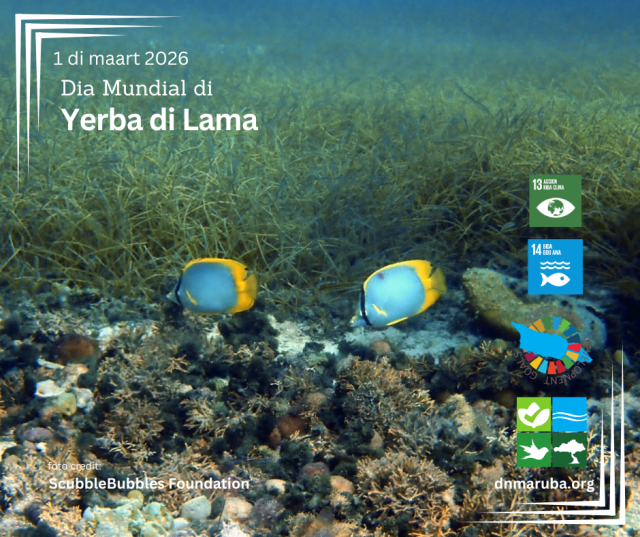
World Seagrass Day: Protecting a Vital Marine Heritage for Our Island
ORANJESTAD – March 1st is World Seagrass Day, dedicated to recognizing one of the most productive and vital ecosystems on our planet.
In Aruba, seagrass meadows play a vital role in the health of our coasts and beaches, marine biodiversity, and the development of our economy. The Department of Nature and Environment (DNM) wants to raise awareness of the importance of these international days established and celebrated by the United Nations. World Seagrass Day, proclaimed by the United Nations General Assembly in 2022, aims to raise awareness of the importance of seagrass meadows worldwide.
Seagrass is often overlooked in comparison to coral reefs, but it is among the most productive and valuable ecosystems on the planet. Although often confused with algae, seagrass is unique because it is the only flowering plant in the sea with roots, stems, and flowers. It forms vast underwater savannas that serve as the lungs of our ocean. It's also important to emphasize that local laws protectseveral types of seaweed.
Why is seagrass important for Aruba?
Seagrass isn't just a "weed in the water," but a shallow-growing plant species that is essential to Aruba's ecology and economy:
- Biodiversity refuge: Seagrass meadows serve as nurseries for many fish species, seahorses, and sea turtles, such as the green sea turtle. Without seagrass, biodiversity declines significantly.
- Natural filter: Seagrass purifies the water by trapping sediment and pollutants. It keeps our ocean clear, healthy, and attractive to residents and visitors.
- Climate change and blue carbon: Although seagrass covers only about 0.1% of the global seabed, it stores up to 18% of the ocean's carbon. For Aruba, this represents important natural protection against the effects of climate change.
- Coastal protection: Seagrass meadows reduce wave action and provide a natural defense against beach erosion and flooding during inclement weather. An endangered resource.
Unfortunately, we lose approximately 7% of these habitats worldwide each year. In Aruba, the main threats stem from:
- Accelerated coastal development;
- Pollution and land-to-sea runoff;
- Boating and anchoring, which pull seagrass from the seabed;
- Dredging and climate change.
Action and protection
DNM emphasizes that protecting seagrass is directly linked to the United Nations Sustainable Development Goals (SDGs). By protecting our seagrass, we also protect our food security, water quality, and the blue economy.
Human activities and behaviors along our coastline seriously threaten Aruba's seagrass. We urge the community and the next generation to focus more onthe value of seagrass. Let's stop viewing seagrass as a "nuisance" on the beach and recognize it as an indispensable natural protection for our coast.