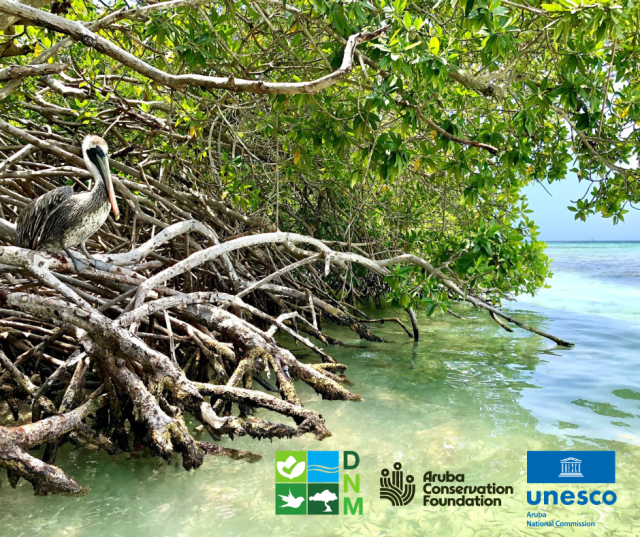
International Day for the Conservation of the Mangrove Ecosystem: Aruba's Status as a UNESCO Biosphere Reserve Strengthens Mangrove Protection
ORANJESTAD – On July 26, the whole world celebrates the International Day for the Conservation of the Mangrove Ecosystem.
For Aruba, this date holds extra special meaning this year.
With Aruba's recent designation as a UNESCO Biosphere Reserve, the protection and restoration of our mangrove areas have become a priority in our island's long-term work program.
The Department of Nature and Environment (DNM), UNESCO Aruba, and the Aruba Conservation Foundation (ACF) have joined forces to convey a single message to the residents of Aruba: protecting our mangrove trees is not just the responsibility of one department or foundation, but an essential component of the comprehensive plan for sustainable development in Aruba.
The Importance of Mangrove Forests as Part of the 'Power of 3'
Mangrove forests do not work in isolation to shape the ecosystem. Together with seagrass and coral reefs, they form the 'power of three': three interconnected ecosystems that jointly protect our coastline against erosion, storms, and water pollution. They support marine life and seabirds, while enhancing resilience against climate change, including sea-level rise. Because the health of one ecosystem depends on the health of the others, protecting all three is essential.
In this context, UNESCO launched the regional project "MangRes" (Mangrove Restoration: Nature-Based Solutions in Biosphere Reserves of Latin America and the Caribbean) in 2022. This three-year initiative focuses on the assessment, restoration, and protection of mangrove ecosystems by integrating scientific and local knowledge. Although the project began in biosphere reserves across the region (such as in Mexico, Peru, Colombia, Cuba, Ecuador, Panama, and El Salvador), it offers Aruba the opportunity to exchange knowledge, research, and scientific best practices with this regional network. Our status as a UNESCO Biosphere Reserve serves as a reminder that caring for our ecosystems is a shared responsibility among governments, organizations, and the entire community. DNM recognizes the ongoing efforts to conserve this ecosystem so that our environment grows healthier and both people and biodiversity benefit.
What Does the UNESCO Biosphere Reserve Designation Mean for Aruba?
To ensure our community is well informed, DNM, UNESCO Aruba, and ACF are jointly sharing the following details about this recognition:
- A balance between people and nature: A biosphere reserve is not a new national park, nor does it mean that the entire island becomes a restricted protected area. It is an international recognition that Aruba is committed to finding a balance between nature conservation, cultural heritage protection, community well-being, and sustainable economic development.
- Nothing changes immediately in daily life: The designation marks the beginning of a long-term collaborative process. The next step involves the Aruban government establishing a management committee to develop a management plan for the UNESCO Biosphere Reserve. This plan will be drafted in collaboration with the community, trade unions, researchers, the private sector, and NGOs.
- A vision of Aruba's marine environment as a connected system: Unlike the protected areas managed by ACF (such as Arikok National Park, Spanish Lagoon, and marine protected areas), the biosphere reserve views Aruba's land and sea as a single connected system. This recognizes that what happens outside protected areas directly impacts what happens within them, and vice versa.
- The biosphere reserve consists of 3 types of zones: To achieve a balance between protection and development, the reserve is divided into:
- Core zone: Areas that are already legally protected due to their ecological value. Most mangrove trees—though not all—are located here.
- Buffer zone: Areas surrounding the core zone where research, education, monitoring, and sustainable activities are encouraged and supported.
- Transition zone: Where most of us live, work, and engage in economic activities in a way that is sustainable and in harmony with nature.
An Invitation to the Aruban Community
Conserving the mangrove ecosystem and holding 'Biosphere Reserve' status does not grant UNESCO legal authority over our decision-making; all decisions remain entirely in the hands of Aruba. However, to maintain this prestigious title, Aruba must continue to uphold the goals and principles of the biosphere reserve model.
DNM, UNESCO Aruba, and ACF invite the entire community to celebrate the International Day for the Conservation of the Mangrove Ecosystem and to learn more about the value these trees provide us. Taking care of our mangrove areas contributes directly to safeguarding Aruba's future.