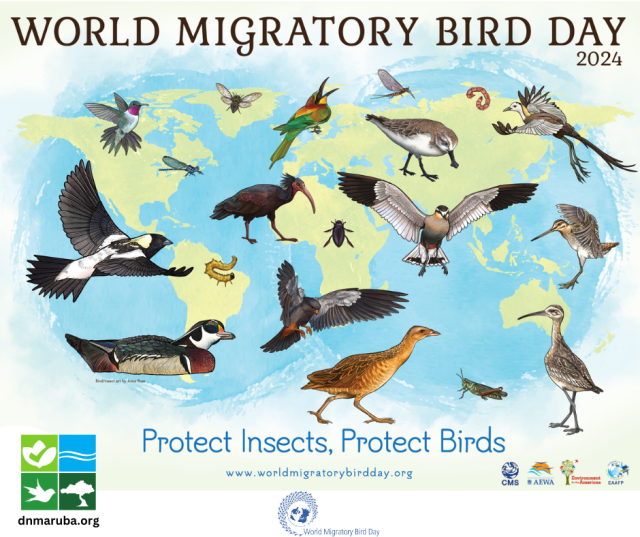
World Migratory Bird Day 2024: Protection of Insects for Bird Well-being
ORANJESTAD - 'World Migratory Bird Day' (WMBD) is a global campaign that takes place twice a year to raise awareness about the need for migratory birds and their habitat conservation.
World Migratory Bird Day is celebrated on the second Saturday in May in North America and Canada, while in the Caribbean, South America, Central America, and Mexico, it is celebrated on the second Saturday in October.
These days, the focus is on the challenges faced by migratory birds, their ecological importance, and the necessity of international cooperation for their conservation.
Every year, thousands of migratory birds worldwide make long journeys and visit Aruba to rest, refuel, or breed before returning to their country of origin.
This year, the Directorate of Nature and Environment (DNM) is focusing on the vital importance of insects for the survival of these birds before, during, and after their long journey.
For the first time, a campaign highlights the importance of insects, such as food for migratory birds, and the threats faced by insect populations.
Insects contain many nutrients and are a source of protein for migratory birds. The presence of insects contributes to the birds' journey. During their stopovers at various locations along their route, the birds search for insects in forests, marshes, or other habitats. They also search for insects in the air or hunt for them in vegetation.
Their navigational instincts, environmental cues, and tactics allow for the massive mass migration of birds across continents.
Migration is a complex behavior serving ecological, evolutionary, and survival purposes. Without insects as food during the long flight, bird migration is threatened.
DNM calls on the community to consider the following points to protect bird migration:
- The presence of insects affects the weather, duration, and overall success of bird migration. During the journey, birds stop at various locations along their route. They search for insects in agricultural areas, forests, marshes, wetlands, and other habitats;
- Birds that eat insects consume a wide variety of insects. It includes bees, beetles, flies, grasshoppers, butterflies, and even aquatic invertebrates such as dragonflies. Therefore, it is not always advisable to spray insecticides. Birds that eat insects help control insect pests that can damage crops or spread diseases;
- 85% of flowering plants require pollination, often done by insects. If we lose our pollinators, our plants will struggle to produce, including the birds that depend on them;
- Maintaining and restoring water-rich areas such as dams, marshes, and wetlands is essential for protecting groups of waterfowl that eat insects;
- Observing and monitoring migratory birds using science, including community involvement, helps raise awareness. Through educational campaigns on the environment and nature, crucial data is provided to restore and manage essential habitats that benefit migratory birds and insects.
Let us reflect on the importance of the various migratory birds that exist. Not only to admire them but also to recognize their importance and dependence on insects.