International Ozone Day
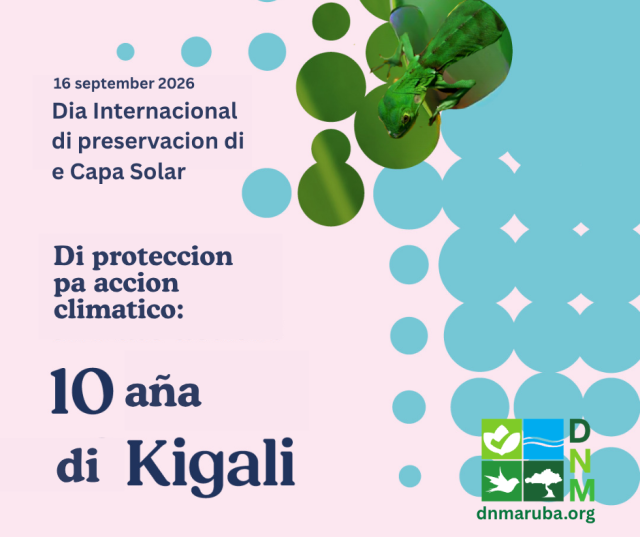
ORANJESTAD — September 16 marks the observance of International Day for the Preservation of the Ozone Layer.
The Directorate of Nature and Environment (DNM) invites the entire community to reflect on one of the greatest environmental achievements of our time: the Montreal Protocol and, more recently, the Kigali Amendment.
Under the 2026 theme, "Global action for a cooler planet" (lower temperature), we celebrate ten years of the Kigali Amendment—a historic commitment transforming the fight against climate change.
The success of the Kigali Amendment and its global impact
The Montreal Protocol was originally created to eliminate substances that destroy the ozone layer. However, many of the substances introduced to replace them, known as hydrofluorocarbons (HFCs), are not harmful to the ozone layer, but are gases with extremely powerful greenhouse effects that contribute to global warming. In 2016, the Kigali Amendment was adopted to reduce the production and consumption of HFCs worldwide.
Ten years later, evidence shows that:
- Reducing global warming: The phase-out of HFCs can avoid an increase of up to 0.5 degrees Celsius in global temperature by the end of this century.
- Technological transition: The agreement has prompted industry to innovate and develop cooling systems that are more energy-efficient and environmentally friendly.
- Multilateral action: It demonstrates that when nations, science, and industry work together, it is possible to achieve substantial environmental objectives without compromising economic development.
What does the 2026 theme mean for Aruba?
For a semi-arid tropical island like Aruba, the theme "Global action for a cooler planet" has a direct and practical relevance. As a territory vulnerable to the consequences of climate change—such as sea-level rise, rising temperatures, and threats to our marine ecosystems (coral life)—this global effort is of vital importance.
In our daily lives, this translates into several key aspects for our community:
- Electricity efficiency in homes and businesses: With increasing temperatures, the demand for air conditioning and refrigeration in Aruba is high. The Kigali Amendment drives the demand for modern appliances that use less electricity, helping lower electricity costs, household consumption, and overall fossil fuel use.
- Refrigerant gas management: Aruba benefits from the regulation and control of imported refrigeration gases, ensuring that technicians and the local refrigeration industry use safer and more sustainable alternatives.
- Protection of our biodiversity: A cooler climate is essential to limit heat stress on our corals, local vegetation, and the marine fauna that depend on regional ecological balance.
Local action for a cooler Aruba: Planting trees in yards and empty spaces
While the Kigali Amendment acts at the industrial and greenhouse gas level, we in Aruba can also take direct action in our own yards and neighborhoods. The goal to plant 100,000 trees around the island is a prime example of how we can contribute. Local trees and shrubs act as the "natural air conditioner" of our soil: they absorb carbon, provide shade, purify the air, and lower temperatures around the home. By supporting and actively participating in the replanting/reforestation plan, every citizen helps create a cooler microclimate, protects our biodiversity, and makes Aruba more resilient against global warming.
As the body responsible for protecting our environment, DNM emphasizes that this year's celebration is a reminder that protecting our atmosphere is not the responsibility of large countries alone, but a joint commitment that benefits everyone. Let's contribute to a cooler planet and a cooler Aruba by adopting sustainable technologies and planting a tree today for tomorrow's generations!
Happy International Ozone Layer Preservation Day 2026!