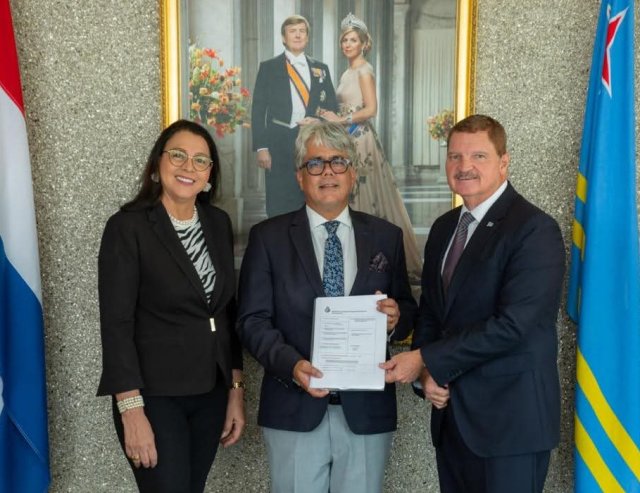
Government Announces Two Historic Legislation
ORANJESTAD – Prime Minister Mike Eman and the Minister of Health, Social Affairs, Elderly Care, and Addiction Care, Mervin Wyatt-Ras, have announced two significant legislative initiatives that will sustainably strengthen Aruba's social foundation.
These are the National Ordinance on Long-Term Care Aruba and the National Ordinance on Compensation for Children with Intensive Care Needs.
With these laws, the government opts for structural solutions based on the Common Good: the well-being, human dignity, and cohesion of Aruban society, both today and in the future.
National Ordinance on Long-Term Care Aruba
Dedicated Legal Framework, Dedicated Fund, and Structural Financing
The National Ordinance on Long-Term Care Aruba introduces, for the first time, a separate legal framework for long-term care in Aruba. This creates a clear distinction between curative care and long-term support, such as elderly care, care for chronic conditions, and care for people with disabilities.
Long-term care will be provided with:
- a separate budget and structural financial support;
- a separate Long-Term Care Aruba fund;
- collective coverage based on solidarity;
Implementation and management will be handled by AZV, within a clear legal framework.
Care will be allocated based on objective assessments and organized into care-intensity products, ranging from home care to residential care in nursing homes. Financing will be tax-neutral through reallocation within existing resources, without increasing the overall administrative burden.
This national ordinance is scheduled to take effect on January 1, 2027.
Allowance for children with intensive care needs
Targeted support for families facing additional daily burdens
In addition, the government is announcing the National Ordinance on Allowance for children with intensive care needs. This law provides a monthly financial allowance for families with children with a disability or condition that leads to a demonstrable intensive care need.
The regulation:
- expands upon social assistance legislation;
- is part of broader social reforms and purchasing power support;
- and, subject to budgetary considerations, aims to provide an allowance of approximately 500 guilders per month per child.
The ambition is to implement this scheme as soon as possible in 2026.
The Common Good as a guiding policy principle
The government explicitly places both pieces of legislation within the framework of the Common Good as a guiding policy principle. Tasks that serve the Common Good require public responsibility, structural and predictable funding, and sustainable institutional embedding.
Experiences with the General Health Insurance (AZV) and the Aruba Tourism Authority (ATA) have shown that public tasks with broad social benefits function better when organized within a clear legal structure, with a stable financial foundation and professional implementation. Both healthcare and tourism are recognized in Aruba as components of the Common Good and are therefore firmly embedded.
In the same vein, the government has chosen to no longer make care for the elderly and other vulnerable groups dependent on ad hoc subsidies or temporary solutions, but to permanently anchor it in legislation, financing, and organization.
Prime Minister Mike Eman states:
“The Common Good is not an abstract concept, but an administrative mandate and a social responsibility. Where the well-being and dignity of people are at stake, the government must provide structure, continuity, and justice, and involve the community broadly. This policy is a direct expression of that.”
Minister Mervin Wyatt-Ras adds:
“With these laws, we recognize people who often remain invisible: our elderly and families with children who require intensive care. We consciously choose security, dignity, and support that is not temporary, but structural and reliable.”
Towards a future-proof social system
With these two laws, the government is taking a decisive step towards a humane, just, and future-proof social system, in which care is not seen as a cost item, but as an investment in people and the community.
The national ordinances will be submitted to the Parliament of Aruba for consideration in the coming period.